

Many NDIS participants and their families don’t realise that short-term and medium-term accommodation options exist to support independent living. These services can transform how people manage transitions, build skills, and get the respite they need.
At Nursed, we’ve seen firsthand how the right STA MTA overview helps participants make informed decisions about their support. This guide walks you through what these services are, who qualifies, and how to find a provider that matches your needs.
Understanding STA and MTA
Short-Term Accommodation (STA) and Medium-Term Accommodation (MTA) are two distinct NDIS funding streams designed for different situations. STA provides funded accommodation for up to 14 consecutive days per stay, with a maximum of 28 days per year, according to NDIS Short Term Accommodation guidelines. It supports planned respite when informal carers provide more than 6 hours of disability-related support daily. MTA offers accommodation while you wait for a long-term home to become available-typically after hospital discharge or during home modifications. The critical difference lies in purpose: STA sustains your informal carers through planned breaks, while MTA bridges a temporary housing gap. Neither covers meals, internet, or electricity; personal care funding remains separate. The 2026-27 NDIS pricing schedule distinguishes accommodation costs from support hours, meaning a 1:1 staffing arrangement in STA can cost more daily than a shared 1:3 setup due to how funding is claimed.
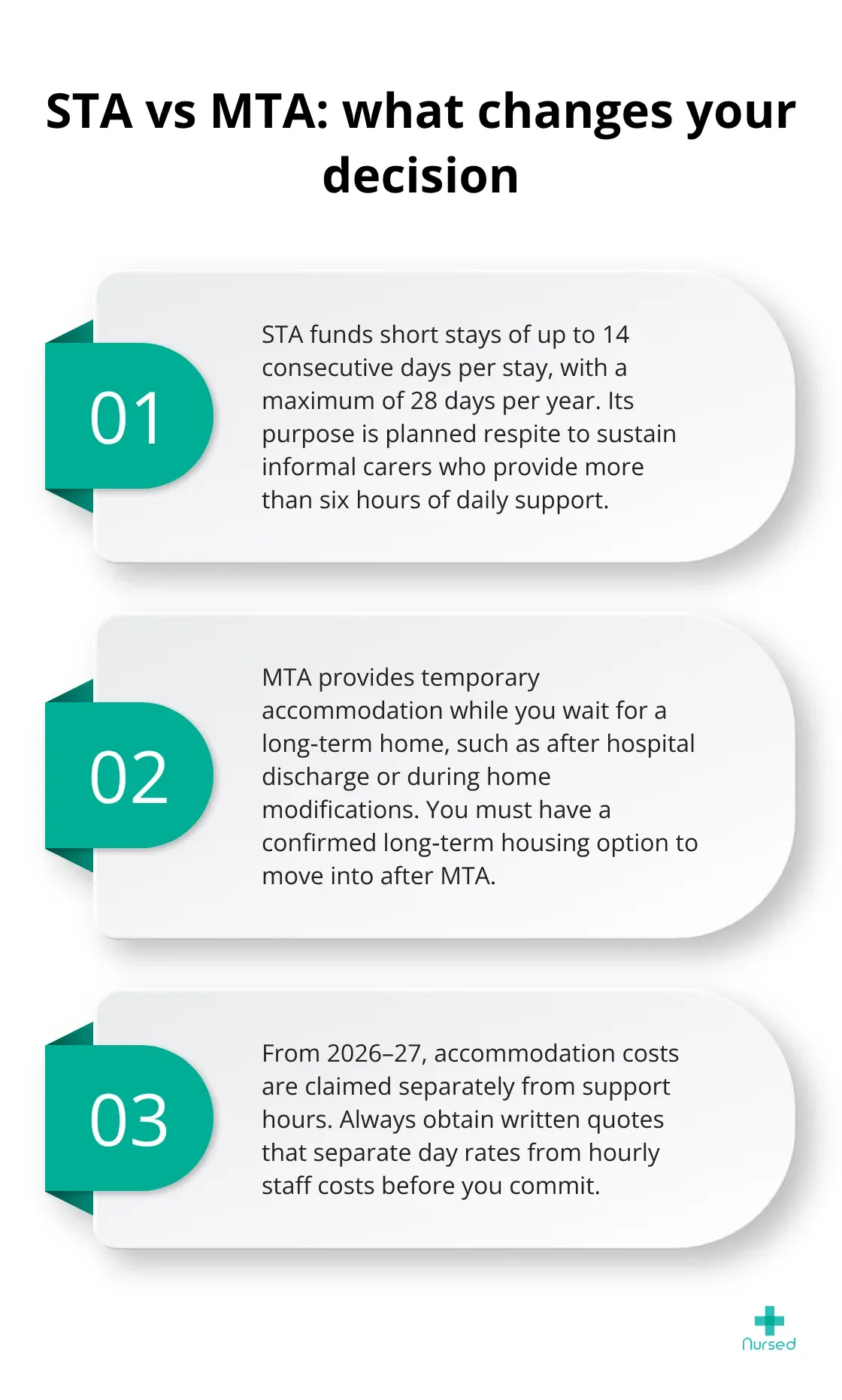
This shift from the old all-in daily rate makes it essential to obtain written quotes that separate accommodation day rates from hourly staff costs before committing to any arrangement.
Eligibility Criteria for STA
You qualify for STA if informal carers provide more than 6 hours of disability-related support daily, or if you have high-intensity needs, behavioural support requirements, rural isolation, or multiple family members sharing care responsibilities. You won’t qualify if you live independently without drop-in supports, already receive more than 18 hours of paid daily supports, or use Supported Independent Living (SIL) or Independent Living Options (ILO) arrangements. The NDIS requires formal evidence of need, including occupational therapy or psychology reports and a letter from informal carers explaining their role and why respite is necessary. Children rarely access more than 60 days of STA annually, highlighting the need for careful planning during youth.
Eligibility Criteria for MTA
For MTA, eligibility hinges on having a long-term home to move into after the MTA and being unable to move into that home. Regional availability matters significantly; some areas like South Australia have limited respite options, with placements potentially 300–400 kilometres away. You must provide evidence of long-term housing or modifications, such as a tenancy offer from a Specialist Disability Accommodation provider, social housing tenancy, or letters confirming offers with approved home modification dates.
Funding Mechanics and Plan Variations
STA funding comes from your Core Support budget under Assistance with Daily Living and can be used flexibly-as a single 14-day block, weekend breaks, or multiple shorter stays throughout the year. MTA uses a separate accommodation component capped at $162.85 per day nationally, with higher rates in remote or very remote areas. If STA or MTA isn’t already in your plan, you can request inclusion during your planning meeting or plan review, or contact My NDIS to discuss using Core funding flexibly. A support coordinator can streamline this process significantly, obtaining necessary documentation and connecting you with suitable providers. If you face an urgent situation-such as a carer crisis-Carer Gateway provides immediate support by calling 1800 422 737, while plan variations can be lodged through the main NDIS line at 1800 800 110. Always verify the latest pricing schedule before budgeting, as rates update periodically and differ between regions.
Finding the Right Provider Match
The provider you select shapes your entire STA or MTA experience. Quality providers maintain transparent pricing, offer flexible booking options, and employ staff trained in disability support. You should ask potential providers about their staffing ratios, accessibility features (ramps, wide doorways, accessible bathrooms, adjustable beds), and what their all-inclusive daily rate covers. Confirm whether meals, activities, and transport are included or charged separately, as this affects your total costs. Request written quotes that separate accommodation day rates from hourly staff costs, and verify these figures against the current NDIS pricing schedule. Providers across Australia offer STA and MTA options, though availability varies by location-contact your preferred provider’s care team for area-specific enquiries. A support coordinator can help you evaluate options and match your needs with a provider that aligns with your goals and preferences, setting the foundation for your transition into longer-term housing arrangements.
What Real Benefits Do STA and MTA Actually Deliver
STA Prevents Carer Burnout
STA solves a genuine problem that affects thousands of Australian families. The primary benefit isn’t theoretical independence-it’s the practical ability to stay in your current living arrangement longer because your informal carers receive the break they desperately need. The NDIS Short Term Accommodation guidelines specify that STA targets people whose informal carers provide more than 6 hours of disability-related support daily.
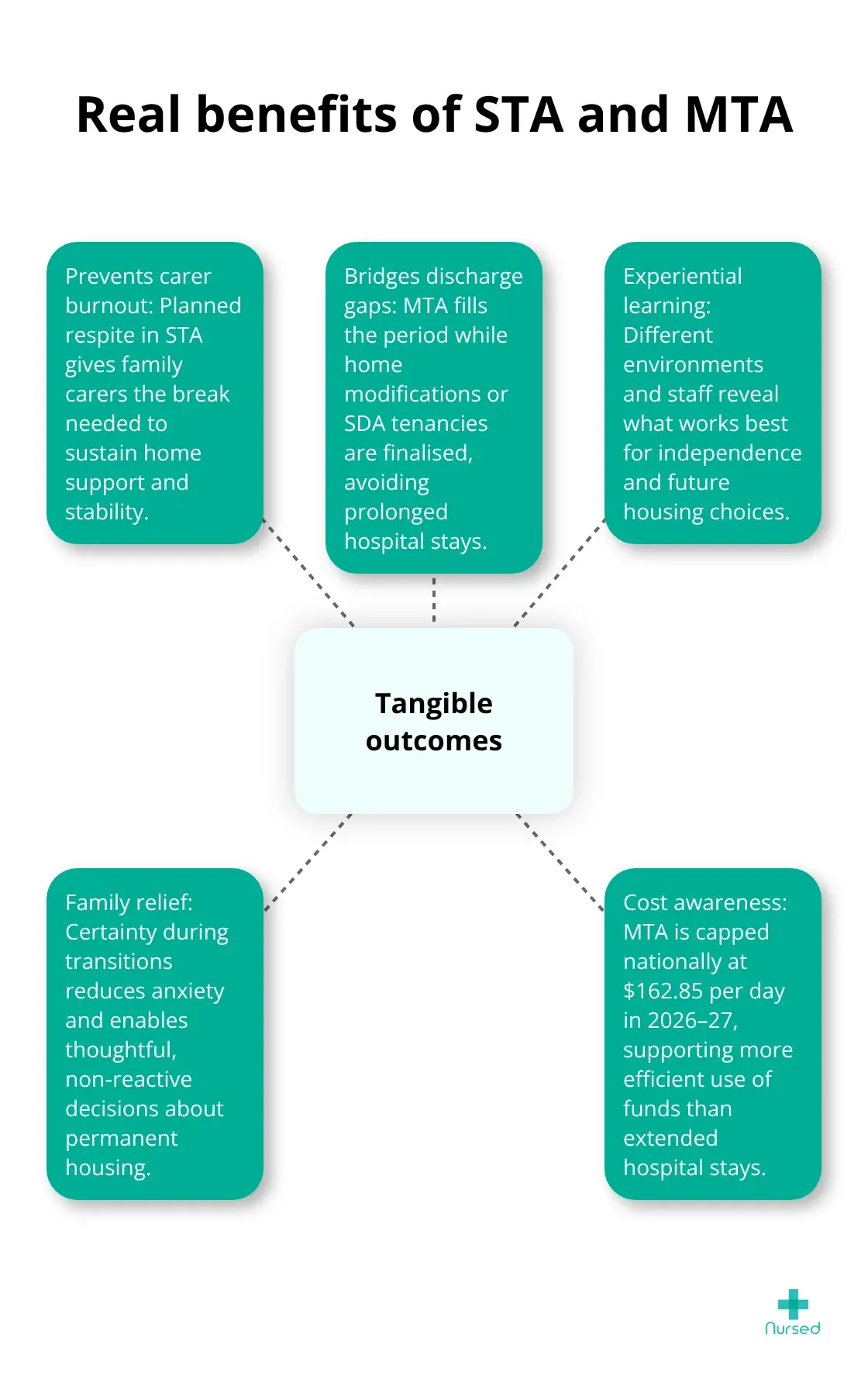
Without that respite care, many family carers reach burnout within 18 months to 2 years, forcing crisis housing decisions. When you access STA for 28 days per year, you give your parents, partner, or sibling a genuine holiday. More importantly, you prevent the collapse of the support system that keeps you at home.
MTA Bridges Hospital Discharge Gaps
MTA solves an equally practical problem: hospital discharge delays. When you are medically cleared to leave hospital but your home modifications won’t finish for another 60 days, or your Specialist Disability Accommodation tenancy won’t be available for 90 days, MTA fills that gap. Without it, you either remain in hospital at considerable cost to the health system or move into unsuitable temporary housing. The NDIS pricing for MTA caps accommodation at $162.85 per day nationally in 2026-27, making it substantially cheaper than extended hospital stays while you wait for permanent housing.
Experiential Learning Through Different Environments
STA and MTA aren’t training programs-they’re accommodation services. What actually happens is that participants gain confidence and independence through exposure to different environments and staff. You learn how different support workers approach tasks, you experience living in an accessible space designed specifically for disability, and you discover what works when you’re not in your usual routine. When you return home after two weeks in STA, you often bring back practical ideas about how your own space could be arranged differently or how your support could be structured. MTA participants frequently report that living in purpose-built accessible accommodation clarifies what features matter most for their long-term housing decisions. This experiential learning informs better housing choices without formal skill development.
Relief for Families During Transitions
For families, MTA provides enormous relief during transitions. Parents managing hospital discharge for an adult child can focus on finalising long-term housing arrangements without the stress of arranging emergency temporary accommodation or navigating unsuitable options. The certainty of knowing your child has a safe, accessible place for the next 90 days removes a significant source of anxiety during an already stressful period. This stability allows families to make thoughtful decisions about permanent housing rather than reactive ones made under pressure.
Understanding these tangible benefits helps you evaluate whether STA or MTA aligns with your current situation. The next step involves identifying which option suits your needs and finding a provider who can deliver the quality support you deserve.
Finding a Provider Who Actually Delivers
Assess Staffing Stability and Ratios
Selecting an STA or MTA provider means identifying who will consistently deliver safe, accessible accommodation with staff that understand your support needs. Start by asking potential providers about their staffing turnover rate. High turnover signals instability, which means new staff learn your routines and preferences constantly. Reputable providers track this metric and share it without hesitation.
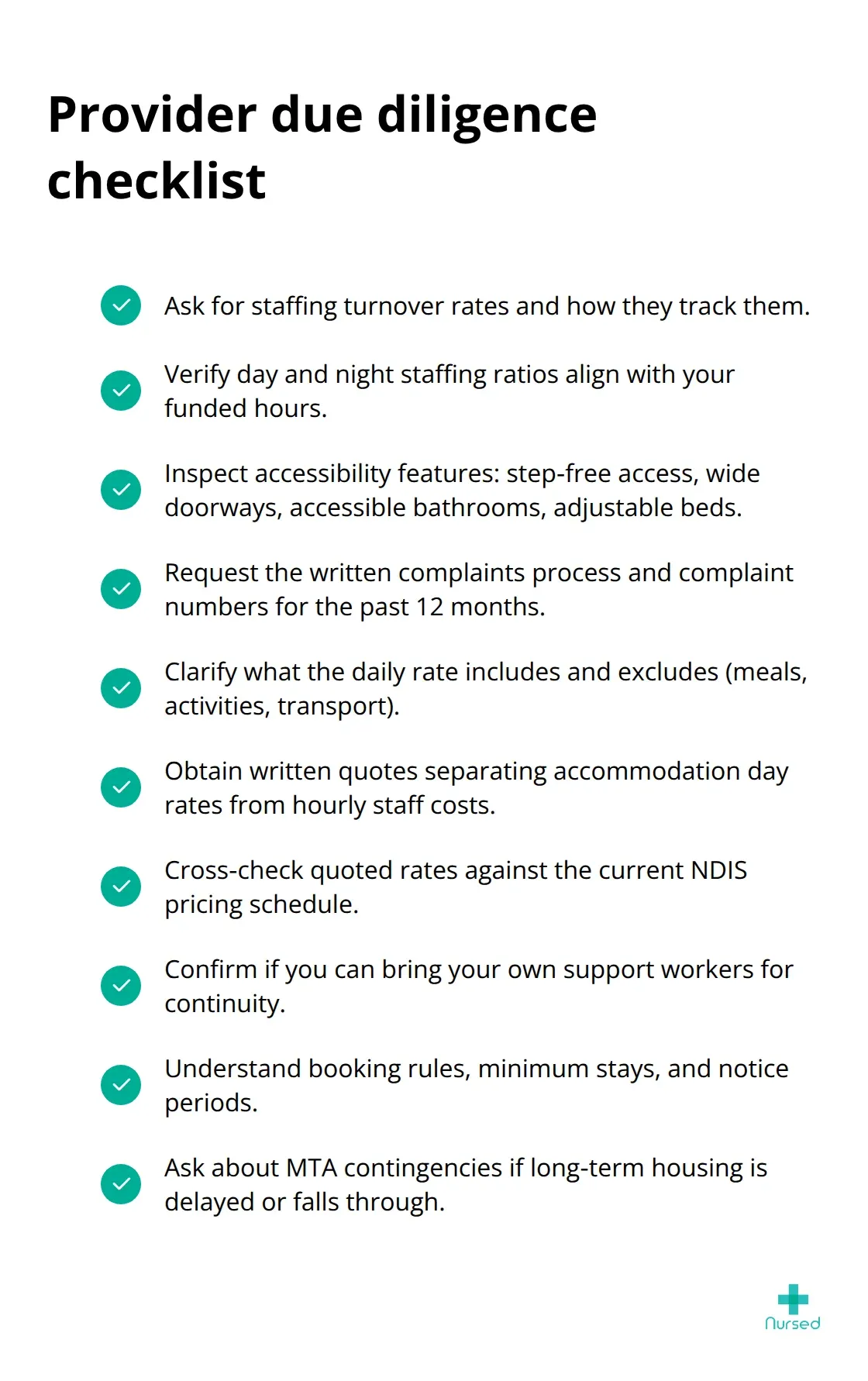
Request their current staffing ratios for both day and night support, then verify these match your plan’s funded hours. The 2026-27 pricing schedule means you pay separately for accommodation and support hours, so misaligned ratios cost you significantly more. Ask about their accessibility features in concrete terms: Do they have step-free access, or do they claim accessibility without it? Are bathroom grab rails height-adjustable, or fixed? Can beds adjust electronically, or only manually?
Inspect Properties and Verify Safety Standards
Visit the actual property if possible before committing. Photos on websites don’t show you whether hallways are wide enough for your equipment or if the layout creates barriers you hadn’t considered. Verify their insurance covers participants and check how they handle incidents or complaints. Request their complaints process in writing and ask how many formal complaints they received in the past 12 months. Transparency here matters enormously.
Clarify Costs and What’s Included
When you contact potential providers, ask specifically about what their daily rate includes and what it excludes. The NDIS coverage details specify that STA covers accommodation, personal care, and participation during your stay, but not meals or travel for family members. Some providers bundle meals into their accommodation rate; others charge separately. This distinction changes your actual costs dramatically.
Request written quotes that separate the daily accommodation rate from hourly staff costs, then cross-check the accommodation figure against the current NDIS pricing schedule to confirm it falls within the daily cap for STA or MTA. Ask whether they allow you to bring your own support workers or require you to use their staff. Flexibility here gives you continuity if you already have support workers you trust.
Understand Booking Flexibility and Contingencies
Find out their booking process and minimum stay requirements. Can you book individual weekends, or do they require full-week blocks? How far in advance must you book? For MTA specifically, ask what happens if your long-term housing falls through after 60 days. Do they have a contingency plan, or will you face displacement? This question alone separates responsible providers from those that create potential crises.
Providers across Australia offer STA and MTA options, though availability varies by location. Contact your preferred provider’s care team for area-specific enquiries. A support coordinator can help you evaluate options and match your needs with a provider that aligns with your goals and preferences, setting the foundation for your transition into longer-term housing arrangements.
Final Thoughts
STA and MTA solve real problems that affect thousands of Australian families every year. STA prevents carer burnout by providing 28 days of annual respite, while MTA bridges gaps between hospital discharge and permanent housing. This STA MTA overview demonstrates that the right accommodation service strengthens your independence and keeps your support system intact during critical transitions.
Contact your support coordinator or local area coordinator to discuss adding STA or MTA to your plan if it isn’t already there. If you need immediate assistance, call the NDIS on 1800 800 110 to explore plan variations, or contact Carer Gateway on 1800 422 737 if you face urgent carer support needs. Research providers in your area and request written quotes from at least two options before you decide.
We at Nursed understand that navigating accommodation options feels overwhelming, and as a registered NDIS provider, we support participants through every stage of this process. Our team helps you access the respite or transition support you deserve, ensuring your accommodation choice strengthens your independence and community connection. Contact us to discuss how STA or MTA might fit into your support plan.