


Family caregiving is exhausting. Between managing appointments, therapies, and daily support, many carers reach a breaking point without regular breaks.
At Nursed, we know that respite care for families isn’t a luxury-it’s a lifeline. Your NDIS plan can fund the relief you need, and this guide shows you exactly how to access it.
What NDIS Respite Care Actually Does
NDIS respite care is funded support that gives your informal carers a planned break while your NDIS participant continues receiving safe, quality care. The National Disability Insurance Agency funds this as Short Term Accommodation, or STA, under Core Supports-Assistance with Daily Life. The NDIS typically allocates up to 28 days per year, and you can use it flexibly as single nights, weekends, or multi-day blocks depending on your needs. STA requires at least one overnight stay and a maximum of 14 days per stay, though extensions are possible in exceptional circumstances. The funding covers accommodation, personal care, meals, and 24-hour support staff in a dedicated facility or supported environment.
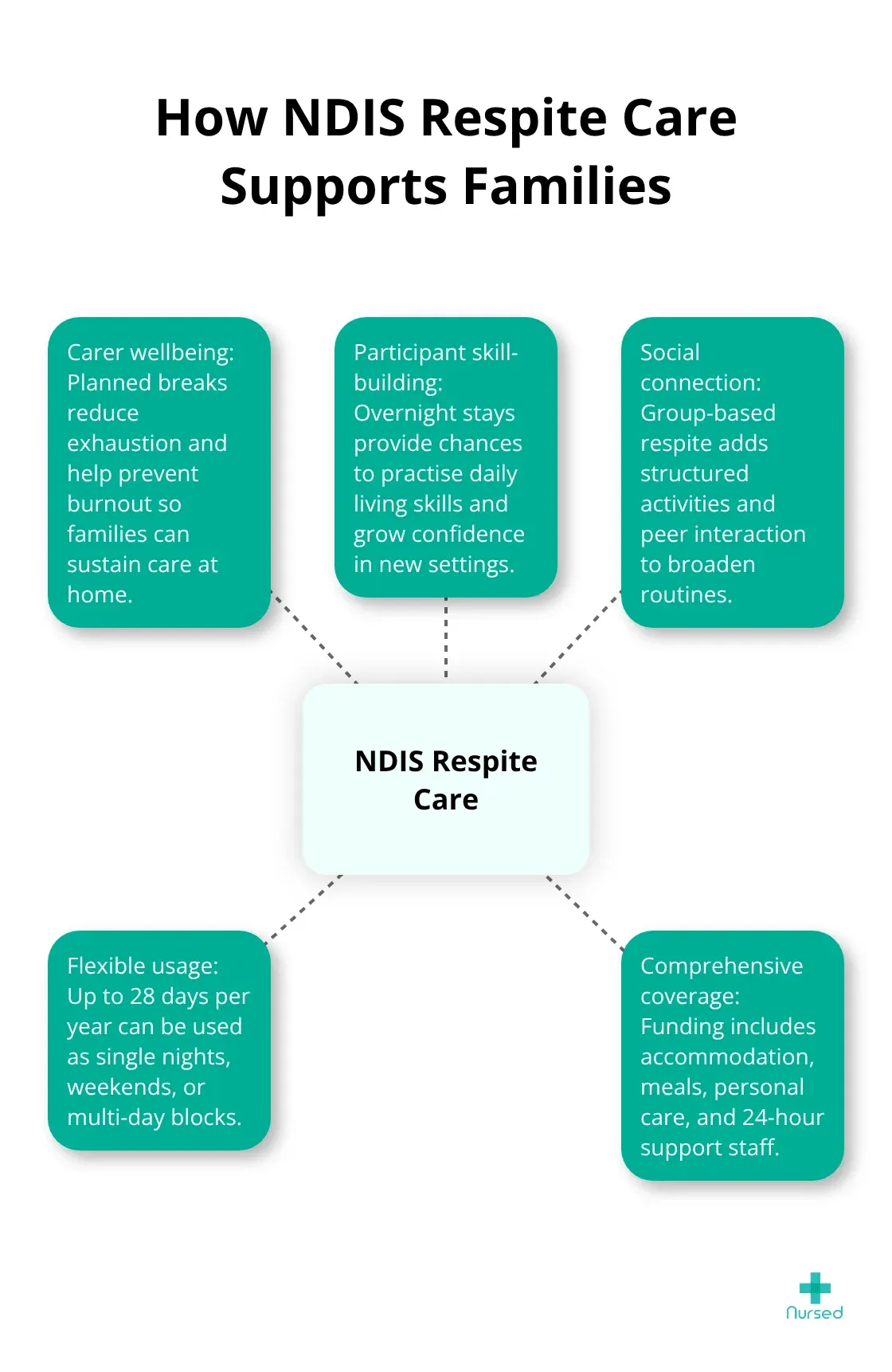
This isn’t about holidays or capacity-building activities; it’s about sustaining the informal care system that keeps families functioning. Without respite, carers face burnout at alarming rates. Research shows that unpaid carers feel underappreciated and burnt out.
Why Respite Matters for Your Family
Carers use respite for specific, practical reasons: they need rest or sleep, attend personal or medical appointments, manage travel or family emergencies, and maintain their own wellbeing. When you access respite regularly, you protect the entire care arrangement. Carers who take planned breaks remain more engaged, patient, and capable of providing quality support over the long term. For the NDIS participant, respite offers real benefits beyond just giving carers a rest. Overnight stays in a supported setting allow participants to practise daily living skills like self-care, communication, and decision-making in a new environment. Many participants build confidence, try new routines, and develop independence during respite experiences. Some participants even progress toward longer-term goals such as transitioning to supported accommodation. Group-based respite adds another layer of value, offering structured activities, social connection with peers, and opportunities to broaden routines beyond home.
Respite Care Types and What Sets Them Apart
In-home respite brings a trained carer to your home, preserving familiar routines and keeping your participant in their comfortable space. Centre-based respite offers structured day programmes with social activities but typically involves travel. Short Term Accommodation stands as the most common NDIS-funded option, providing overnight stays in a 24/7 supported facility with accommodation, meals, and activities included in the daily rate.
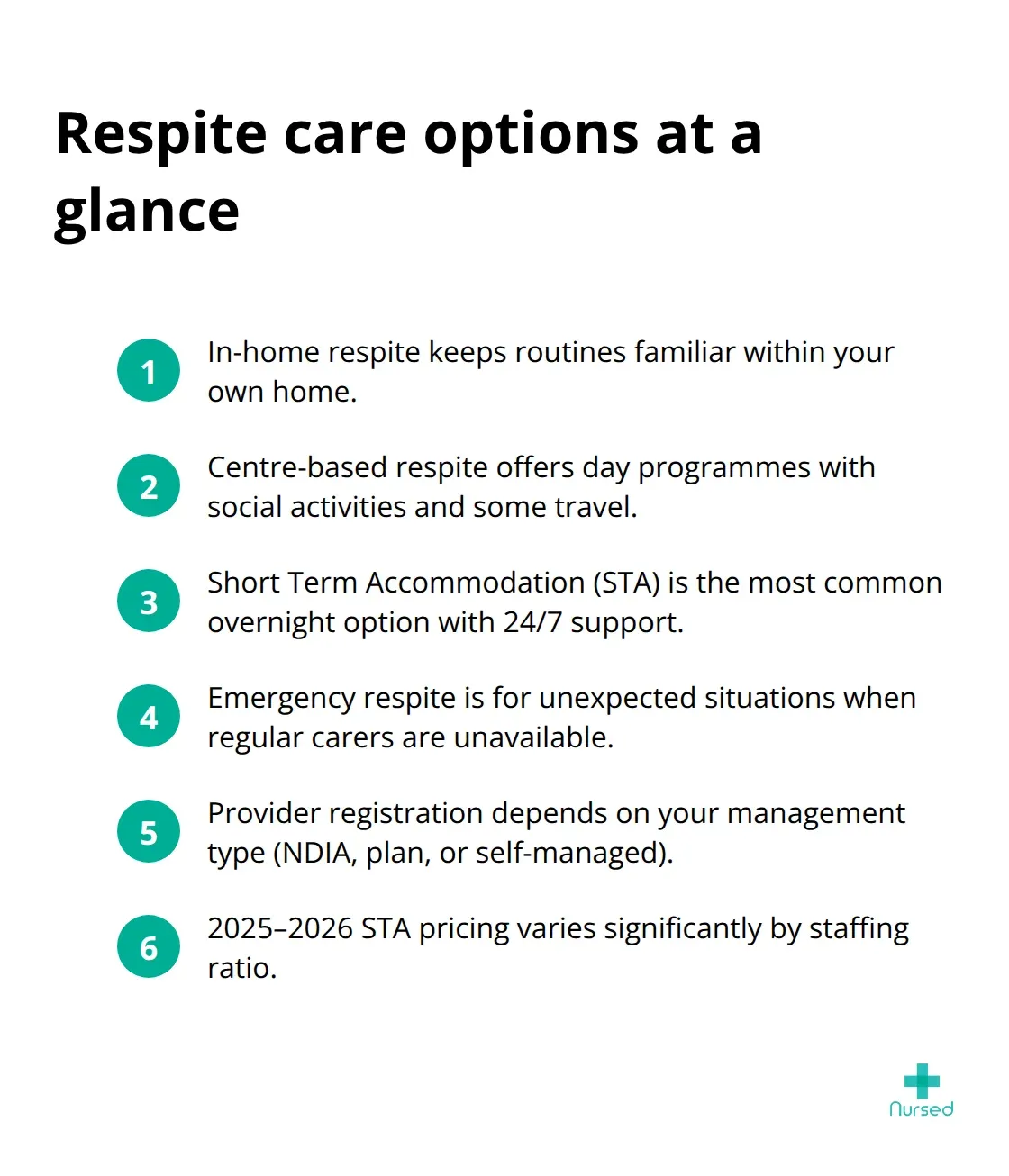
Emergency respite exists for unexpected situations when your regular carer becomes unavailable. If you’re agency-managed through NDIS, your provider must be registered; if you’re self-managed or plan-managed, you can choose any provider. The 2025–2026 NDIS price limits for STA vary significantly by staffing ratio. Understanding these costs helps you plan which option delivers the best value for your situation.
Moving Forward with Your Respite Strategy
The right respite option depends on your participant’s comfort, current routines, and specific goals. Some families prefer in-home respite to maintain consistency, while others find that Short Term Accommodation builds independence more effectively. Your choice also reflects what your informal carers need most-whether that’s a complete break at home or the assurance that their loved one experiences new environments and social opportunities. The next step involves assessing your family’s actual respite needs and working with your NDIS planner to include this support in your plan.
Planning Your Respite Care Strategy
Identify What Your Family Actually Needs
Start by identifying exactly what your family needs from respite care, not what you think you should need. Write down the specific reasons your informal carers require breaks: medical appointments they’re missing, sleep deprivation, work commitments, or the physical and emotional toll of constant caregiving. Be honest about frequency too. Some families need weekly overnight respite, while others manage with monthly weekend blocks. The NDIS funds up to 28 days per year, so if your carers need breaks every second weekend, that’s roughly 24 days already accounted for. This specificity matters because vague requests face questioning during planning meetings.
Gather Evidence That Demonstrates Real Need
When you meet your Local Area Coordinator or Support Coordinator, bring evidence of your carer’s actual situation. A letter from your informal carer describing their role, workload, and how respite would prevent burnout carries far more weight than a general statement. If your carer has a health condition, a GP letter helps. If you manage multiple caring responsibilities, professional reports from occupational therapists or psychologists strengthen your case significantly. The NDIA assesses respite as reasonable and necessary, which means you must demonstrate that without these breaks, your current care arrangement risks breaking down. This isn’t hypothetical-it’s about showing genuine need.
Choose Between In-Home Respite and Short Term Accommodation
The choice between in-home respite and short-term accommodation depends entirely on what serves your participant’s development and your carer’s wellbeing best. In-home respite keeps everything familiar and consistent, which suits participants who struggle with transitions or have complex routines requiring precise execution. Short Term Accommodation, however, builds independence and confidence faster because participants navigate new environments, interact with different staff, and practise skills away from home. The 2025–2026 pricing shows STA with 1:2 staffing costs around $1,199 on weekdays and $1,502 on Saturdays, making it cost-effective compared to 1:1 options at $2,179 weekdays.
Connect Respite to Your Participant’s NDIS Goals
If your plan includes STA, ask your provider exactly what’s included in that daily rate-accommodation, meals, activities, and personal care should be bundled, though some providers charge separately for extras like transport or specialised therapies. When your planner asks about respite, connect it explicitly to your participant’s NDIS goals. If independence is a goal, explain how STA builds that. If social participation is listed, describe how group respite activities support it. Goals-based language gets approval faster than general requests.
Prepare Documentation and Request Respite Formally
Prepare a costed quote from your chosen provider showing dates, number of nights, staff ratios, daily price, and what’s included. This removes ambiguity and helps planners assess value for money. If you’re NDIA-managed, your provider must be registered; if self-managed or plan-managed, you have freedom to choose any provider. Request respite during your planning meeting or plan review rather than waiting for crisis situations to force the conversation. Once your planner approves respite funding, the next step involves selecting a provider who understands your participant’s specific needs and can deliver consistent, quality support.
Getting Started with Respite Care
Find and Vet Your Respite Provider
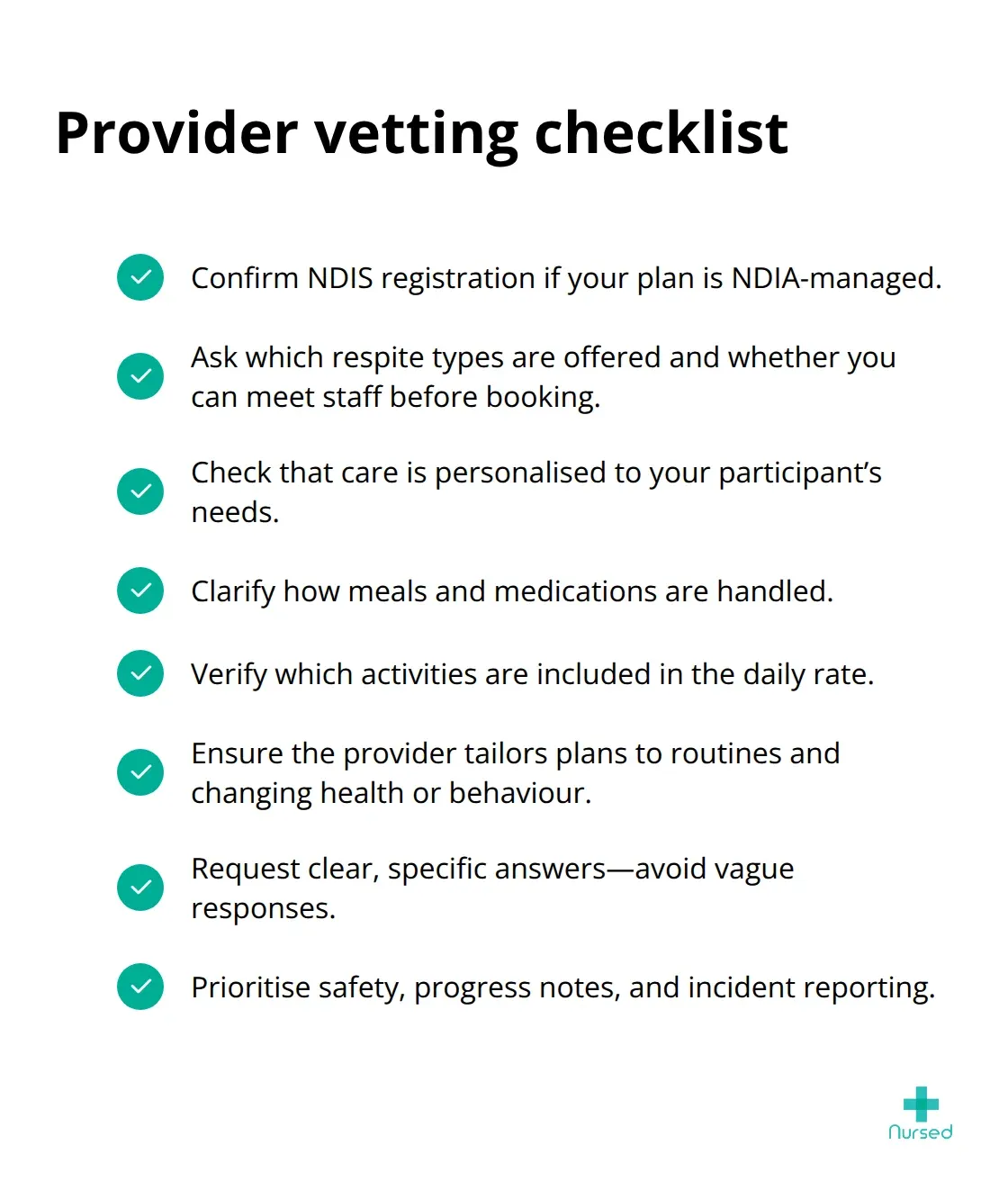
Once your NDIS plan includes respite funding, you need to find a provider who understands your participant and delivers consistent quality care. If your plan is NDIA-managed, your provider must be NDIS-registered, which means they meet Practice Standards and face audits by the NDIS Commission. Self-managed and plan-managed participants have more flexibility but should still prioritise registered providers because they deliver safer, higher-quality care with incident reporting and progress notes.
Start by contacting three to five providers in your area and ask specific questions: what respite types do you offer, can we meet staff before booking, is care personalised to our participant’s needs, how do you handle meals and medications, and what activities are included in the daily rate? A good provider will tailor plans to your participant’s specific routine and adapt to changes in health or behaviour. Don’t accept vague answers-this is your participant’s safety and your carer’s peace of mind at stake.
Compare Costs and Service Inclusions
When you receive quotes, compare what’s actually included. The 2025–2026 NDIS price limits show STA with 1:3 staffing costs vary by time of day, with weekday daytime rates at $73.58 per hour, but some providers bundle activities and meals into their daily rate while others charge separately. Request a detailed breakdown so you know exactly what your funding covers and what might incur additional costs.
Once you’ve selected a provider, ensure the respite appears clearly in your Core budget under Assistance with Daily Life. Create a Service Booking if your plan is NDIA-managed, sign a Service Agreement, and confirm cancellation terms and notice periods upfront. Lock these details in writing before your first stay.
Prepare for Your First Respite Stay
Your first respite experience should feel manageable, not overwhelming. Coordinate with your provider to schedule the stay when your informal carers most need relief, whether that’s a single night to start or a full weekend. Many families find that shorter initial stays help both participant and carers adjust to the separation.
Share detailed information about your participant’s routines, preferences, dietary needs, medication schedules, and any triggers or communication strategies that matter. Providers who take time to understand these specifics deliver better outcomes and reduce anxiety for everyone. After your first respite stay, ask your provider for progress notes and feedback on how your participant managed-did they sleep well, engage with activities, eat properly, and interact with staff? This information matters for future stays and for demonstrating progress at your next plan review.
Build a Sustainable Respite Routine
Sustainable respite means scheduling regular stays rather than using them sporadically. Families who book monthly weekend respite or quarterly week-long blocks see better outcomes than those who scramble for ad-hoc respite during crises. Regular scheduling gives your participant time to adjust and build confidence, allows your informal carers to plan their own activities with certainty, and prevents the care arrangement from fracturing under stress.
Discuss with your provider about block bookings and whether they offer cost efficiencies for regular, predictable use of your 28 funded days per year. If you’re looking for a provider who combines personalised support with community integration, Nursed offers respite care designed to support both your participant’s independence and your carer’s wellbeing.
Final Thoughts
Respite care for families works because it addresses a real problem: carers cannot sustain quality support without planned breaks. The NDIS funds up to 28 days per year specifically to prevent burnout and keep informal care arrangements functioning. When you access respite regularly, you protect the entire system that supports your participant, and your carers gain the rest they need to continue their role effectively.
Your path forward starts with honesty about what your family actually needs. Write down the specific reasons your carers need breaks, gather evidence from health professionals and your carer themselves, and connect respite directly to your participant’s NDIS goals (this approach gets approval faster and ensures the support you receive matches your real situation). Contact your Local Area Coordinator or Support Coordinator and raise respite at your next planning meeting with a letter from your informal carer and any professional reports that support your case.
We at Nursed understand that respite care for families requires providers who genuinely understand your participant’s needs and deliver personalised support. If you’re ready to explore respite options that prioritise both your participant’s independence and your carer’s wellbeing, contact Nursed to discuss how we can support your family’s respite journey.